When both x and y are repeatedly measured and there is a group-level relationship between them and there is missing data, the default for brms results in a misspecified model (I think!).
make_data <- function(
    n_groups=20,
    n_per_group = 5,
    y_int_mean = 5,
    y_int_sd=.5,
    y_sigma = 0.35,
    x_coef=2.3,
    x_sigma=0.1,
    seed=1,
    miss_type = c("random","groupwise"),
    missingness = 0,
    output_type=c("full","pergroup"),
    plot=FALSE
){
  miss_type <- match.arg(miss_type,miss_type)
  output_type <- match.arg(output_type,output_type)
  set.seed(seed)
  n_groups <- 20
  y_int_mean <- 5
  y_int_sd <- 0.5
  y_int_groups <- rnorm(n_groups,0,y_int_sd)
  x_coef <- 2.3
  x_true <- runif(n_groups)
  y_true <- y_int_mean + y_int_groups + x_true*x_coef

  # Take repeated measurements of x_true and y
  n_per_group <- 5
  y_sigma <- 0.35
  y_obs <- unlist(sapply(y_true,\(i)rnorm(n_per_group,i,y_sigma),simplify = F))
  x_sigma <- 0.1
  x_obs <- unlist(sapply(x_true,\(i)rnorm(n_per_group,i,x_sigma),simplify = F))

  groups <- rep(1:n_groups,each=n_per_group)

  if(plot){
    plot(y_obs~x_obs,col=groups)
    abline(lm(y_obs~x_obs),lty=2)
    abline(a=y_int_mean,b=x_coef)
    legend(
      "topleft",
      legend = c("true relationship",paste0("this instance (seed = ",seed,")")),
      lty = c(1,2)
    )
  }

  ## Put it in a big data frame -------------------------------------------------

  dat <- tibble(
    groups = as.factor(groups),
    y_obs = y_obs,
    x_obs = x_obs,
    y_true = rep(y_true,each=n_per_group),
    x_true = rep(x_true,each=n_per_group)
  ) %>%
    group_by(groups) %>%
    mutate(
      y_obs_mean_per_group = mean(y_obs),
      x_obs_mean_per_group = mean(x_obs)
    ) %>%
    ungroup()

  ### Add missing values ----------------------------------------------------
  if(miss_type=="random") {
    assertthat::assert_that(missingness>=0 && missingness < 1)
    mis <- if_else(!rbinom((n_groups*n_per_group),1,missingness),1,NA)
    dat <- dat %>%
      mutate(x_obs = x_obs*mis)
  } else {
    is.whole <- function(x, tol = .Machine$double.eps^0.5) abs(x - round(x)) < tol
    assertthat::assert_that(is.whole(missingness))
    mis <- sample(unique(dat$groups),size = missingness)
    dat <- dat %>%
      mutate(x_obs = if_else(groups %in% mis,NA,x_obs))
  }

  attr(dat,"true_intercept") <- y_int_mean
  attr(dat,"true_slope") <- x_coef

  if(output_type == "full"){
    return(dat)
  } else {
    return(
      dat %>%
        drop_na() %>%
        group_by(groups) %>%
        filter(n()>1) %>%
        summarise(
          y_obs1=mean(y_obs),
          x_obs1=mean(x_obs),
          n=n(),
          sd_y=sd(y_obs),
          se_y=sd_y/sqrt(n-1),
          sd_x=sd(x_obs),
          se_x=sd_x/sqrt(n-1)
        ) %>%
        rename(y_obs = y_obs1, x_obs = x_obs1)
    )
  }
}

library(tidyverse)
library(brms)
options("brms.backend" = "cmdstanr")
library(marginaleffects)
library(tidybayes)

dlist <- lapply(1:10,\(x) make_data(seed=x,missingness = .3))


# set_rescor(FALSE): Default brms behaviour ----------------------------------

bf_no_rescor <- bf(y_obs ~ mi(x_obs) + (1 | groups)) +
  bf(x_obs | mi() ~ 1 + (1 | groups))
bmer_no_rescor <- brm_multiple(
  bf_no_rescor,
  data = dlist,
  prior = c(
    prior(student_t(3,0,2.5),class=b,resp=yobs)
  ),
  seed=1L,
  chains=4,
  cores=4,
  iter=2000,
  combine = FALSE
)
bmer_no_rescor[[1]]

p1 <- lapply(
  bmer_no_rescor,
  \(x) plot_predictions(
    x,
    condition = "x_obs",
    re_formula = NA,
    resp = "yobs",
    draw = F
  )
) %>%
  bind_rows(.id="Model") %>%
  ggplot()+
  geom_abline(
    intercept = attributes(dlist[[1]])$true_intercept,
    slope = attributes(dlist[[1]])$true_slope
  )+
  geom_lineribbon(
    aes(x=x_obs,y=estimate,ymin=conf.low,ymax=conf.high,colour=Model,fill=Model),
    alpha=0.4
  )+
  facet_wrap(vars(Model))+
  theme_minimal()+
  labs(title="Model with set_rescor(FALSE) [default behaviour]")


#  set_rescor(TRUE) --------------------------------------------------

bf_rescor <- bf(y_obs ~ mi(x_obs) + (1 | groups)) +
  bf(x_obs | mi() ~ 1 + (1 | groups)) +
  set_rescor(TRUE)
bmer_rescor <- brm_multiple(
  bf_rescor,
  data = dlist,
  prior = c(
    prior(student_t(3,0,2.5),class=b,resp=yobs)
  ),
  seed=1L,
  chains=4,
  cores=4,
  iter=2000,
  combine = FALSE
)
bmer_rescor[[1]]

p2 <- lapply(
  bmer_rescor,
  \(x) plot_predictions(
    x,
    condition = "x_obs",
    re_formula = NA,
    resp = "yobs",
    draw = F
  )
) %>%
  bind_rows(.id="Model") %>%
  ggplot()+
  geom_abline(
    intercept = attributes(dlist[[1]])$true_intercept,
    slope = attributes(dlist[[1]])$true_slope
  )+
  geom_lineribbon(
    aes(x=x_obs,y=estimate,ymin=conf.low,ymax=conf.high,colour=Model,fill=Model),
    alpha=0.4
  )+
  facet_wrap(vars(Model))+
  theme_minimal()+
  labs(title="Model with set_rescor(TRUE) [non-default behaviour]")

patchwork::wrap_plots(p1,p2,guides = "collect")
Output of the code:
bmer_no_rescor[[1]]
Family: MV(gaussian, gaussian)
  Links: mu = identity
         mu = identity
Formula: y_obs ~ mi(x_obs) + (1 | groups)
         x_obs | mi() ~ 1 + (1 | groups)
   Data: data[[i]] (Number of observations: 100)
  Draws: 4 chains, each with iter = 2000; warmup = 1000; thin = 1;
         total post-warmup draws = 4000

Multilevel Hyperparameters:
~groups (Number of levels: 20)
                   Estimate Est.Error l-95% CI u-95% CI Rhat Bulk_ESS Tail_ESS
sd(yobs_Intercept)     0.63      0.15     0.37     0.96 1.01      660      954
sd(xobs_Intercept)     0.27      0.06     0.18     0.41 1.01      603     1193

Regression Coefficients:
               Estimate Est.Error l-95% CI u-95% CI Rhat Bulk_ESS Tail_ESS
yobs_Intercept     5.99      0.24     5.55     6.46 1.01      896     1622
xobs_Intercept     0.51      0.06     0.38     0.63 1.00      847     1444
yobs_mix_obs       0.64      0.38    -0.11     1.39 1.01      808     1090

Further Distributional Parameters:
           Estimate Est.Error l-95% CI u-95% CI Rhat Bulk_ESS Tail_ESS
sigma_yobs     0.30      0.02     0.26     0.35 1.00     3104     3079
sigma_xobs     0.11      0.01     0.09     0.14 1.00     1599     2389

bmer_rescor[[1]]
Family: MV(gaussian, gaussian)
  Links: mu = identity
         mu = identity
Formula: y_obs ~ mi(x_obs) + (1 | groups)
         x_obs | mi() ~ 1 + (1 | groups)
   Data: data[[i]] (Number of observations: 100)
  Draws: 4 chains, each with iter = 2000; warmup = 1000; thin = 1;
         total post-warmup draws = 4000

Multilevel Hyperparameters:
~groups (Number of levels: 20)
                   Estimate Est.Error l-95% CI u-95% CI Rhat Bulk_ESS Tail_ESS
sd(yobs_Intercept)     0.37      0.10     0.20     0.60 1.00      861     1469
sd(xobs_Intercept)     0.31      0.07     0.20     0.46 1.00     1100     1463

Regression Coefficients:
               Estimate Est.Error l-95% CI u-95% CI Rhat Bulk_ESS Tail_ESS
yobs_Intercept     5.31      0.20     4.88     5.70 1.00     1583     1690
xobs_Intercept     0.48      0.07     0.33     0.62 1.00      823     1341
yobs_mix_obs       2.06      0.36     1.36     2.79 1.00     1289     1570

Further Distributional Parameters:
           Estimate Est.Error l-95% CI u-95% CI Rhat Bulk_ESS Tail_ESS
sigma_yobs     0.37      0.04     0.30     0.47 1.00     1229     1915
sigma_xobs     0.11      0.01     0.09     0.14 1.00     1984     2475

Residual Correlations:
                  Estimate Est.Error l-95% CI u-95% CI Rhat Bulk_ESS Tail_ESS
rescor(yobs,xobs)    -0.57      0.12    -0.76    -0.30 1.00     1380     2501
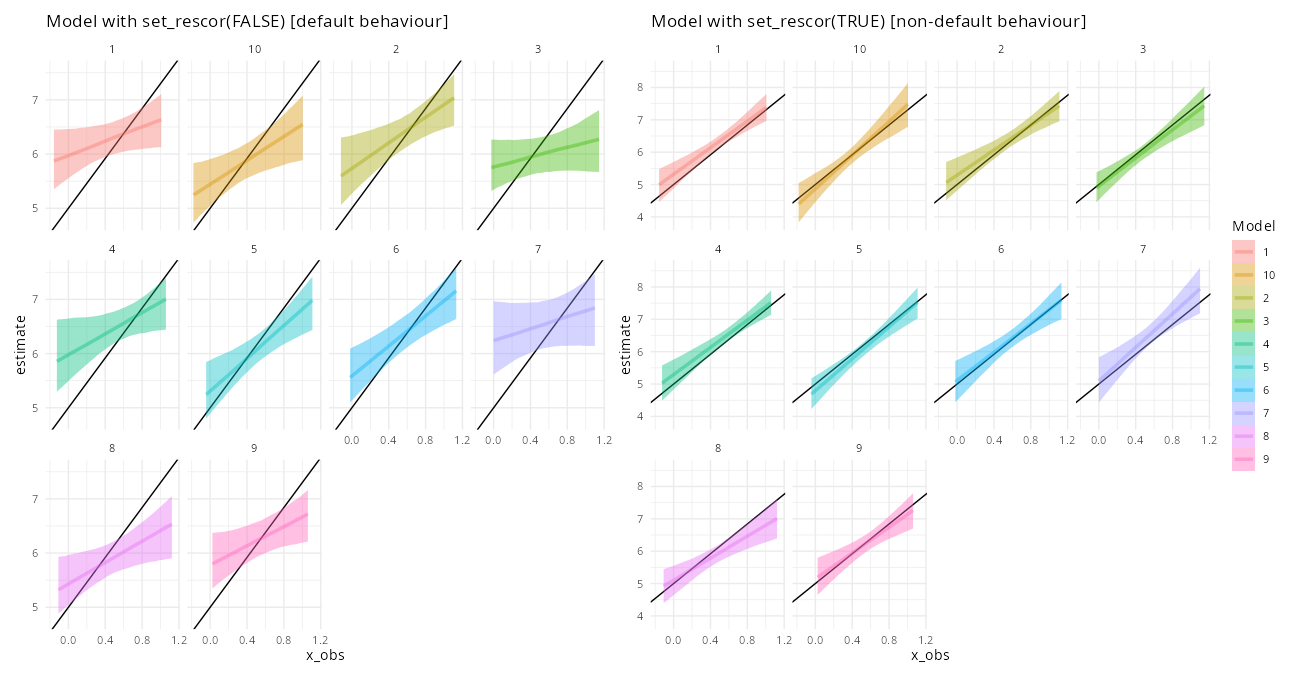
Edit: in the plot the legend title should really be “Data replicate”.
Could someone explain what’s going on here? Why is the rescor element so important? And is the first model actually not misspecified, but instead somehow appropriate given the simulation? Sorry, I’m about to get on a plane so I don’t have time to write a more considered post.
- Operating System: Mint 22.2
- brms Version: 2.23.0